
Amarillo Resident Lookup Records
A resident lookup works best when each source has a narrow role. PRAD and the City GIS map give parcel context, not proof that a person lives there. Potter and Randall court systems hold different case types, while City Vital Statistics and Texas DSHS control vital-record access. VoteTexas answers voter-status questions under election rules. The Potter jail roster, TDCJ, DPS registry, and federal locator each describe a different status. Start with the source whose record could actually prove the fact at issue, then preserve its date and limitations.
| Record source | What it can confirm | Amarillo route | Access condition |
|---|---|---|---|
| Parcel and appraisal record | Parcel, tax-roll association, value context | PRAD property search | Informational, not title or occupancy proof |
| County case record | Case and party information | Potter case information | Online index plus clerk routes |
| Voter status | Registration status within the official process | Texas voter-status entry point | Regulated election data |
| Vital record | Certified event record when eligibility applies | Amarillo Vital Statistics | ID and relationship rules apply |
| Custody or registry record | A specific booking, custody, or registry status | Use the agency that maintains that category | Snapshot, not residence history |
Use an address lead for parcel context, a cause number for court records, and an event date for a vital request. A status tool is not a public list of everyone connected to a street.
Amarillo Name Lookup Anchors
Same-name errors are common in an Amarillo resident lookup. Pair the name with two independent identifiers before drawing a conclusion. Useful anchors include a street and a source date, a county and a case number, an approximate age and a recorded party role, or a parcel account and a legal description. Keep spelling variants together. A middle initial can help, but it is not enough on its own. A court party address in an older filing also does not establish a current Amarillo address.
For a city address, first decide whether Potter or Randall County is responsible. PRAD covers the appraisal district area, while the City GIS map supplies parcel and planning context. A Randall address can then be checked through that county's tax search or clerk routes. When a modern record conflicts with an older directory or filing, record both dates rather than forcing a match. Street renumbering, a delayed index, and a person with the same name can all explain a conflict.
Note: A matching name becomes useful only when the source date and at least one separate identifier support the same person.
Amarillo Court Lookup Routes
Choose the court before searching a name. The Potter District Clerk holds district-court civil, criminal, family, CPS, and related pleadings. The Potter County Clerk holds County Courts at Law, the constitutional county court, and probate material. Justices of the Peace keep their own records. Randall County has parallel clerk and district-clerk paths, and the Amarillo Municipal Court docket is limited to city matters. A county court portal should not be used as though it covers every Amarillo case.
Potter County case information is the online starting point. Potter's notice says access is available around the clock, and the District Clerk office provides public search computers Monday through Friday from 8 to 5. The live county form fields were not verified in the research capture, so use the portal's current labels instead of assuming a field layout. When a county case led to an appeal, re:SearchTX provides statewide court access information, including registers of action and documents under its access and payment workflow.
The City Municipal Court docket can be searched by date, time, and last name, according to the city description. A docket entry records a court event. It is not, by itself, proof of a final outcome.
Potter County case information is the official source shown in the portal image.
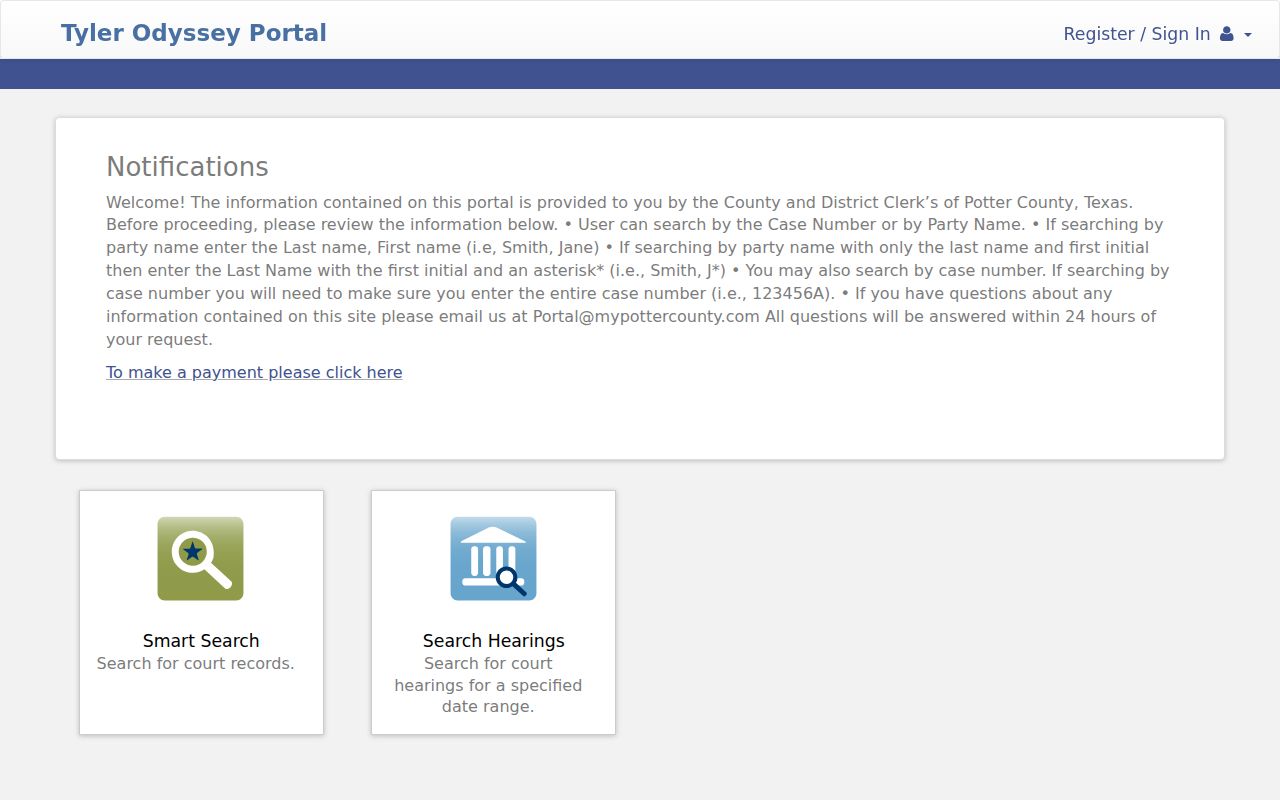
The Potter portal image is a useful reminder to save the cause number, case style, court, and source date before requesting any record from a clerk.
Potter Court Access Numbers
When an online case result is not enough, Potter District Clerk research and copy requests have a documented fallback. The clerk's other-services instructions call for a written or in-person request that identifies the cause number and requested documents. They require a $30 deposit that includes postage and a $5 state-law research fee. The instructions also list $0.50 per uncertified page and $1 per certified page, with cashier's check or money order rather than personal checks.
Potter District Clerk other services is the route for those mechanics. Some court material is confidential by law or order, and staff will not perform searches beyond what a statute requires. For a Randall matter, the Randall District Clerk posts a $5 research fee and encourages online requests, so confirm the county before sending payment or a request.
Note: A certified copy comes from the custodian and carries a different evidentiary role than a screen result or plain index entry.
Amarillo Voter Lookup Status
Texas separates one-person voter-status checking from public voter-list requests. VoteTexas describes three ways to check status: a VUID, a Texas driver-license number if it was supplied at registration, or a first and last name. Registration becomes effective 30 days after acceptance. Returned mail can place a voter in suspense, and address changes go through the official online or written process. These limits matter because the status tool is not a general roster of Amarillo residents.
Use the VoteTexas status guidance and official entry point for the live process. A public list request is different: the state form requires an affidavit, scope, delivery choice, a physical address, and a $75 deposit. A statewide name search application carries a $5-per-query charge. Those controls reflect election-law restrictions, not a shortcut to an address list.
The Texas voter-status entry point is the official source shown in the image.
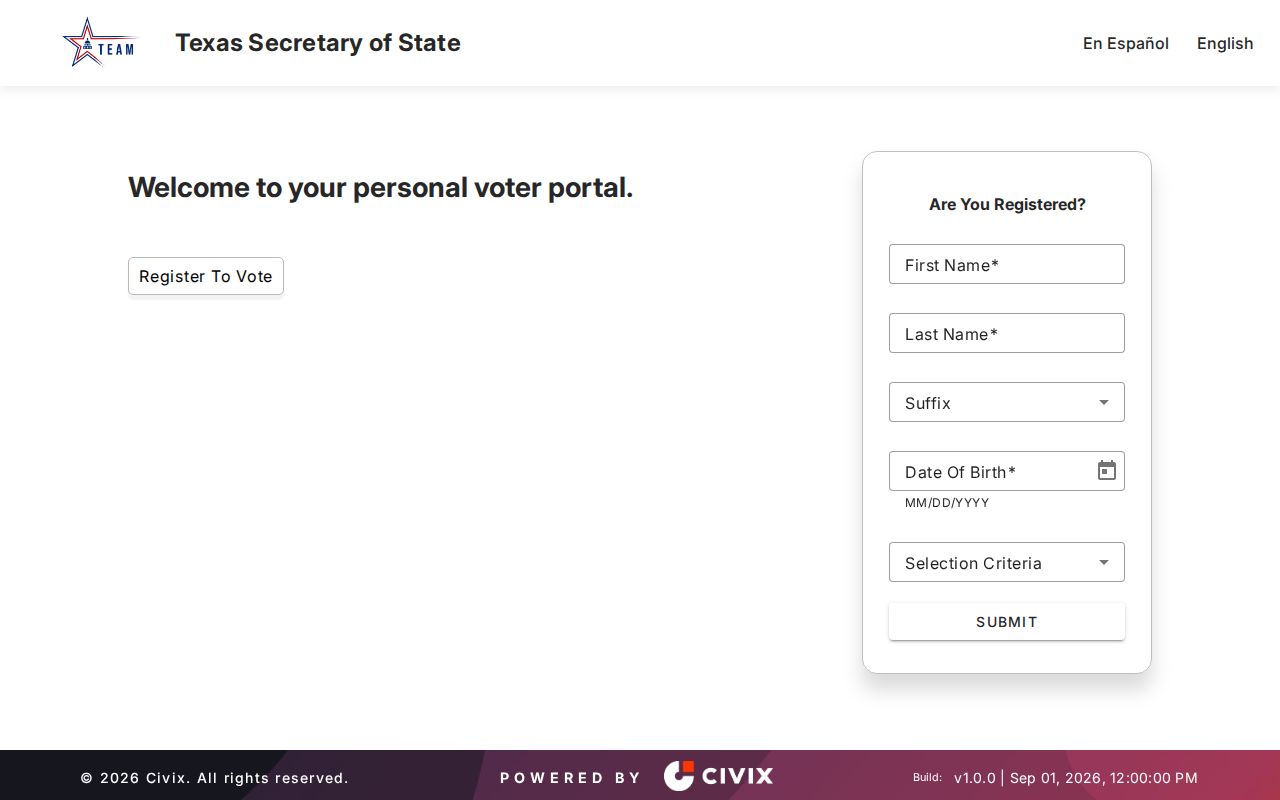
The voter-status image marks the official entry point. Recheck the live form because the research capture could not verify its current field labels or result screen.
Amarillo Vital Records Limits
Vital records are not unrestricted name searches. Amarillo's Permitium ordering portal has separate certified birth and death paths and asks online applicants to upload an approved primary identity document. City Vital Statistics offers remote Texas birth access and local death certificates for Potter County or the City of Amarillo. Mail and in-person routes are also listed. Eligibility generally turns on the person named in the record, a qualifying immediate family relationship, legal representation, or other legal authority.
Texas Government Code §552.115 makes birth records public after 75 years and death records public after 25 years, but the holding office still controls copy and certification procedure. For historical discovery, Texas DSHS vital-record guidance and its index material can be more appropriate than seeking a current certificate. DSHS birth and death indexes can contain gaps or misspellings, and an index is not a legal document. Keep the event date, county, and spelling with any candidate result.
Amarillo's Permitium ordering portal is the official source shown in the image.
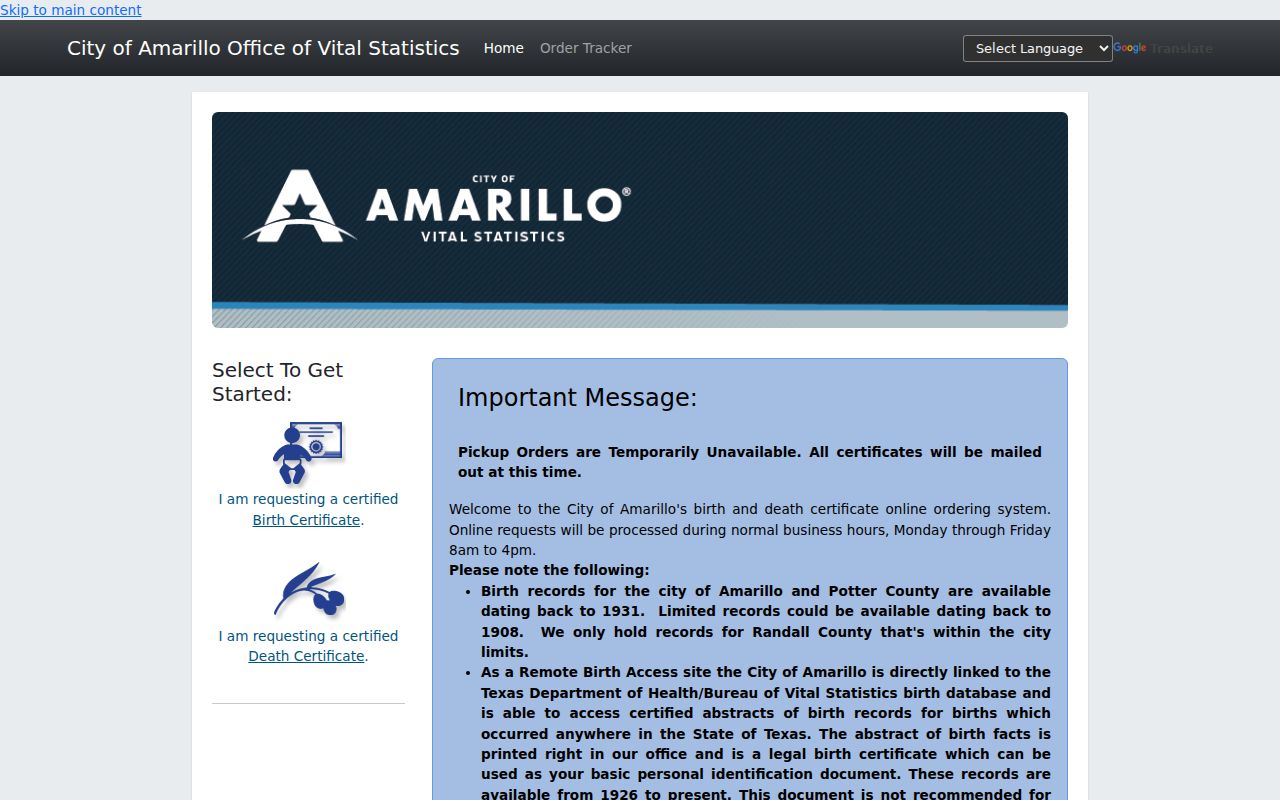
The portal shows the two request paths. Its online process and delivery language should be checked at the time of an order because service details can change.
Amarillo Custody Record Types
Booking, custody, registry, and criminal-history data are separate categories. Potter's public jail portal covers county jail, book-in, and warrant material. The Sheriff's Records Department also accepts in-person public copy requests with a form and picture ID. That local source does not replace a state prison search. It also has a notable city-limit caveat: the county sex-offender list excludes registrants inside Amarillo city limits, where the official DPS statewide registry is the proper route.
TDCJ inmate search accepts a name, SID, or current TDCJ number, and an asterisk can support partial name or SID matching. Its detail view may show a location, offenses, projected release, and notification option. The Texas DPS registry publishes only the fields allowed for that registry, while the federal BOP locator covers federal inmates from 1982 forward. None of these sources establishes an Amarillo residence.
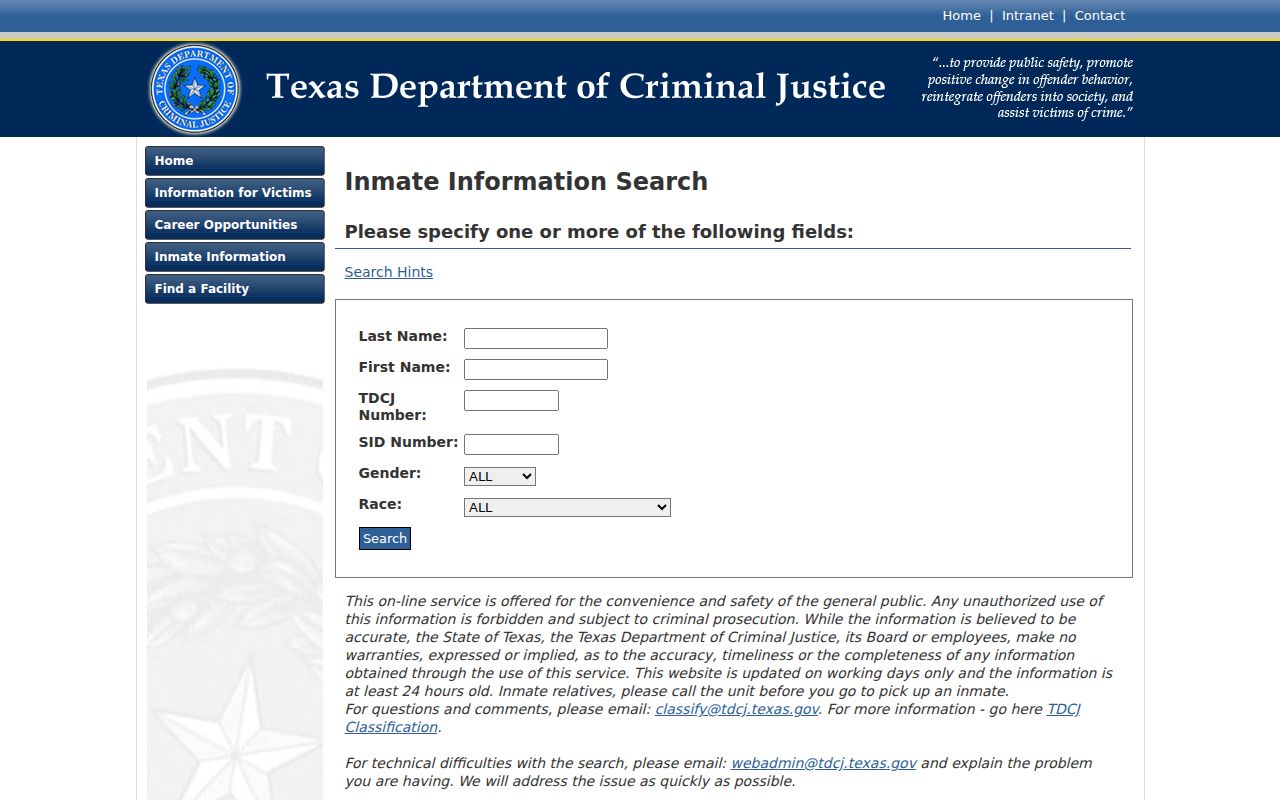
The TDCJ image belongs to a state custody search, not a county booking or current-address record. Label the result by its exact agency and status.
Verifying an Amarillo Resident
A careful resident lookup follows a short chain rather than searching every source at once. Start with the narrowest known fact, then compare a second official source that was created for a different purpose. For example, a parcel can anchor an address, a court file can supply a dated party role, and an authorized vital or historical source can test whether the dates fit. Do not turn a recorded owner, a voter-status result, or a docket name into an unsupported claim about a person's current home.
- Write down the full name, spelling variants, county, and one anchor such as an address, year, cause number, or parcel account.
- Check the official source that matches the question, such as the parcel context, county case portal, voter-status process, or vital-record custodian.
- Compare a second source by source date, county, street, party role, or event details. Preserve conflicts instead of silently choosing one.
- Save the record identifier. Request a certified copy from the right clerk only when official proof is needed.
- Docket
- A court's running list of filings, settings, and events in one case. It may not state the final outcome.
- Index and image
- An index points to a record. An image is a scan of the record and can still be unavailable, redacted, or uncertified.
- Certified copy
- A copy issued or authenticated by the responsible custodian for uses that require official confirmation.
Amarillo Privacy and Lookup Limits
Texas law explains why an Amarillo resident lookup can have gaps. The Texas Address Confidentiality Program gives eligible participants a substitute mailing address and limits disclosure of a residential address. Motor-vehicle personal information has separate DPPA and Texas disclosure protections. Voter data has election-specific restrictions, and vital records remain controlled until their public-access age. A missing address can be a legal protection, not a reason to search harder.
Texas privacy law also provides some rights to access, correct, delete, or opt out with covered businesses that hold personal data. Those rights do not rewrite an official public record. Send a correction request to the office that maintains the record, with the record identifier and the reason for the correction. A defined Texas Public Information Act request should identify an existing record, department, date range, and preferred format rather than demand a compiled profile.
Lawful use. Use official Amarillo records for personal, lawful research. Do not use a name, address, or record detail to stalk, harass, threaten, or intimidate anyone.
Amarillo Source Record Trail
Keep a small record inventory for every candidate result. It makes a later correction possible and prevents one stale screen result from becoming a claim about the wrong person. The best trail records both what an office confirmed and what it did not confirm. For city-held administrative records, route a Texas Public Information Act request to the office that created or maintains the material, not automatically to a court or recorder.
| Source and office | The official custodian and the exact portal or request route used. |
|---|---|
| Search key | Name spelling, address, cause number, instrument number, or other limited key. |
| Date and result type | The search date plus the agency's own wording, such as docket event, booking, index, or certified copy. |
| What it supports | A precise dated fact, along with its access condition and next official step. |
For a past address rather than one person's current record, historical directories give a better dated household trail. The Amarillo city directory resources hold the fuller collections route, while county records remain the place to confirm a specific legal or court record.