
Amarillo Previous Residents Sources
One Amarillo address can leave traces in several kinds of records. The strongest result is not the first name found. It is a sequence of dated evidence that reaches the same street or legal description from independent sources. The recorder supplies instrument history, directories supply annual household clues, newspapers and tax rolls add date context, and maps help interpret a block. Each source has a different time range and a different limit, so its label should stay with the name it supplies.
| Previous-resident source | Years it covers | Where held | What it shows |
|---|---|---|---|
| Potter Official Public Records index | Online dates not published | Potter County portal | Recorded instruments and party roles |
| Hudspeth Amarillo city directories | Selected confirmed issues, 1917 to 1969 | UT directory holding | Yearly name and street clues |
| Amarillo telephone directories | Confirmed 1953, 1960, and 1970 issues | UT catalog holding | Telephone-directory listing leads |
| Amarillo newspapers and tax rolls | Newspaper runs from 1895 to 2002, with gaps | Texas State Library inventory | Dated notices and taxpayer context |
| Sanborn map set | July 1908 | Library of Congress | Block, building, and use context |
Start with the newest parcel and instrument details when the address is known. Start with the directory or newspaper date when the question is about a past household. None of those entries alone confirms continuous occupancy.
Start an Amarillo Address Chain
Normalize the present address first. Confirm whether it lies in Potter or Randall County, then use the Potter-Randall Appraisal District for appraisal and tax context. The City GIS map can show the parcel outline, property lines, and planning layers. Its parcel display is informational and approximate. It is not a survey, a title opinion, or evidence that the tax-roll name lives at the property.
Write down the parcel account, addition, and legal description where they appear. A legal description identifies the lot in the recorded system and is often more stable than a street number. If the address is on the Randall side, use the county's tax search and County Clerk route instead of assuming Potter jurisdiction. The result is a starting record card: modern address, county, parcel or account identifier, legal description, source date, and any known old address form.
That card prevents a common mistake. A tax or appraisal association is one record relationship. The later trail must still find dated occupant evidence before calling anyone a prior resident.
Amarillo Previous Residents Deed Trail
The deed chain begins with a current parcel record and works backward through recorded instruments. In the Potter portal, search by grantor or grantee, subdivision, document type, document number, indexed date, or available OCR full text. Search spelling variants. The portal's exact online coverage start and end dates were not published, so do not assume that an empty result means no older document exists. The County Clerk is the custodian for the recorder function and can explain the certified-copy process.
- Use the appraisal or parcel context to record the legal description and current tax-roll association, without treating that name as proof of occupancy.
- Find the purchase instrument for a recorded party in the official index. Save its instrument number, recording date, document type, and party roles.
- Search the seller as a grantee to locate that person's earlier acquisition, then repeat the sequence one transfer at a time.
- At each link, compare the legal description, addition, and block. Street numbers can change even when the legal description remains useful.
- Request a clerk-certified copy or ask the custodian about older access when the online index or image does not resolve the link.
- Grantor and grantee
- The grantor transfers an interest in an instrument. The grantee receives that interest. Either role may be different from the resident.
- Chain of title
- A sequence of recorded transfers linked by parcel description and dates. It is not a list of everyone who occupied a property.
- Legal description
- The recorded lot, block, addition, or other parcel description used to identify land more reliably than a changing street address.
Potter Index Warnings for Amarillo
The official recorder portal is a research tool, not a certified title record. Its disclaimer says the database may not be complete or unaltered, images can be temporarily unavailable, and redactions may apply under Texas Property Code §11.008(k)(1)-(2). An image in the portal can therefore be useful for a lead while still requiring clerk confirmation for a legal purpose. Preserve the portal's wording instead of converting a search result into a final conclusion.
The Potter recorder disclaimer is the source for those limits and for the portal's warning about authentic records. Search the index first, then compare the available image with the instrument details. A missing image, unreadable scan, or unexpected party role is a signal to ask the County Clerk about the original record or a certified copy.
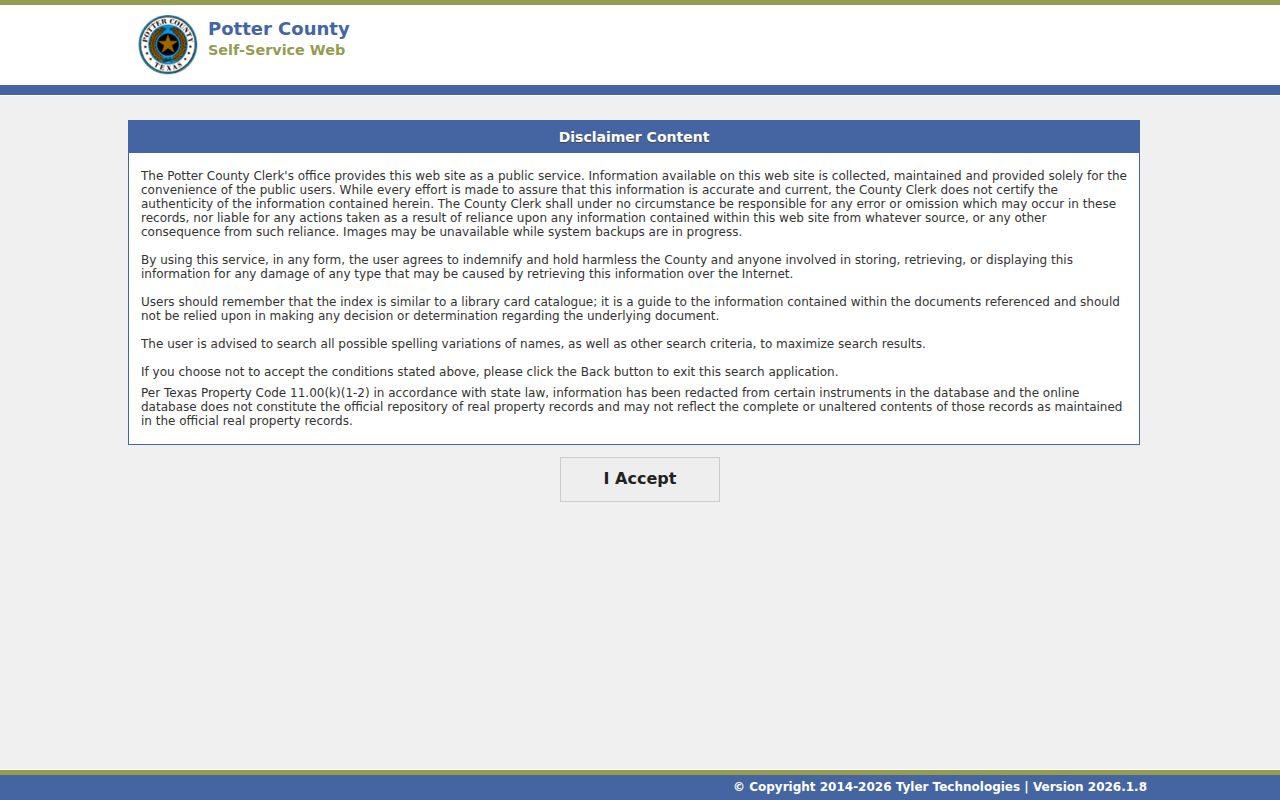
The disclaimer image makes the source boundary plain: an online index points to an official record, but it does not certify title or occupancy by itself.
Amarillo Previous Residents in Directories
Directories provide the household layer that deeds cannot. The UT Center for American History catalogs Hudspeth Directory Company Amarillo issues for 1917, 1918, 1919, 1920, 1921, 1922, 1924, 1927, 1931, 1932, 1933, 1936, 1943, 1947, 1949, 1966, 1967, and 1969. The catalog confirms those selected issues, not every intervening year. A companion telephone-directory holding lists at least January 1953, November 1960, and December 1970.
Read a directory as a yearly publisher-compiled snapshot. Record the name, street and number, publication year, and occupation only when it helps distinguish same-name people. Follow the address through nearby issues. A move, a delay in compilation, or a renumbered street can create a false break. For collection locations and search help, the Amarillo city directory route focuses on the historical shelves rather than the address chain itself.
The Amarillo Library genealogy collection adds newspaper microfilm, Vertical Files, maps, rare Sanborn Map Books, and six genealogy computers. Its Special Collections and Genealogy contact is 806-378-3049, a useful alternative when an issue is not online.
Amarillo Previous Residents Chronology
Pair directory years with other dated material. A directory entry may suggest a person at an address, a newspaper notice can provide a more precise event date, and a tax roll can place a taxpayer in a particular year. TSLAC notes that county tax rolls are grouped by initial rather than strictly indexed, and its microfilm is generally an onsite resource where staff do not conduct full searches. Those limits are part of the evidence trail, not a reason to fill gaps with guesses.
Use a simple three-clock flow: recording date, directory publication date, then apparent occupancy date. A deed may be recorded after signing. A directory may have been compiled before its issue date. A person may move between both. Add a released census schedule only when its location, household, and date can be tied to the same address. This keeps a name from being carried across years without support.
- Put each address form and legal description in date order.
- Place instrument, directory, tax-roll, newspaper, map, and any census evidence on the same chronology.
- Mark agreement, conflict, and missing years separately before labeling an address-associated person as a resident.
Note: A dated directory listing is stronger when a separate map, tax, obituary, newspaper, or court source reaches the same address.
Amarillo San Jacinto Address Shift
Historical Amarillo addresses can change shape. The San Jacinto Neighborhood Plan explains that annexation after the neighborhood's incorporation in 1925 led to street renaming and renumbering. San Jacinto's 5th Street became 6th Avenue, and the former 100 blocks of Fifth became the 2700 block of Sixth. Route 66 arrived in 1926. A search under only the modern name can miss a directory, tax roll, or newspaper entry that used the earlier form.
Keep both names, both block numbers, the addition, any legal description, and nearby intersections on the address card. Search each form in the recorder index, directory volumes, historical newspapers, and maps. The San Jacinto plan history supplies the local conversion, while the recorded parcel description provides a more durable cross-check.
This is an Amarillo records story, not an automatic conversion rule for every old number. Mark the conversion as uncertain unless the sources independently connect the two forms.
Amarillo Sanborn Block Check
Amarillo's July 1908 Sanborn Fire Insurance Map has 18 sheets. It helps answer a different question from a directory: what stood on the block, how a building was used, and which landmarks sat nearby. Search the Library of Congress map record by street, block, building footprint, and intersection. A listed address may turn out to be a hotel, boarding house, church, or commercial building rather than a single dwelling.
The map is a powerful check when the historical number is unclear. Pair its block and building context with a directory street entry, a newspaper notice, or a recorded legal description. It does not identify every occupant and it does not establish title. The 18-sheet count is useful because it encourages checking the right sheet rather than assuming one map covers the whole city.
Amarillo Previous Residents Evidence
Use precise labels at every stage. A person in a deed is a recorded party. A person in a tax roll is a tax-roll name. A directory entry is a directory-listed resident for that publication year. A newspaper or obituary is an address-associated historical source. These labels keep a previous-residents result honest when the sources overlap only partly. The best conclusion has a dated transfer or tax record, a same-address directory or newspaper reference, and a second independent source.
Obituaries and probate material can help explain the end of a trail, but neither should be used to extend a residence claim beyond its date. Potter County Clerk materials include probate and guardianship functions, while the District Clerk holds district-court records. Route a request to the record custodian, not to whichever portal first showed a familiar name. The Potter County Clerk is the main local routing point for recorded instruments and county-court functions.
Lawful use. Amarillo house-history research is for family history, estate matters, and personal curiosity. Do not use a past address trail to harass, track, or threaten a living person.
Amarillo Record Gaps and Requests
Leave a chain open when a source is missing. Potter's online recorder coverage dates were not published in the observed portal, no full year-by-year local directory shelf list was located, and some online images may be unavailable. Amarillo Library, the Panhandle-Plains Historical Museum Research Center, and TSLAC are practical fallbacks when the portal stops. The museum is in Canyon, holds regional newspapers, maps, manuscripts, photographs, and oral histories, and recommends an appointment.
Ask a narrow question: whether the repository holds an Amarillo directory for a named year, whether it includes a street-address index, and whether staff can identify the old street form or call number. For a government-held existing record, send a written Texas Public Information Act request to the office that maintains it, naming the record type, department, date range, address, and desired format. The Potter County Open Records page helps identify which office owns a particular county record.
For present address research along a full street rather than one backward chain, use the Amarillo street directory route. It keeps current address records separate from historical household evidence.